
A new report gathers the main findings, lessons learned and recommendations from the seven AQUAMAN pilot areas, highlighting practical solutions to tackle water scarcity and promote more sustainable and climate-resilient tourism in Mediterranean islands and coastal destinations.
The Interreg Euro-MED AQUAMAN project has brought together the results of its seven Water Scarcity Living Labs in a new report entitled “Conclusions and recommendations from the Interreg Euro-MED AQUAMAN Project Water Scarcity Living Labs”. The document presents the main challenges, experiences and solutions identified across the project’s pilot areas in France, Greece, Italy, Spain, Portugal and Malta. It also provides a set of strategic recommendations to improve water management, encourage cooperation and help Mediterranean tourism destinations become more resilient to climate change.
Seven pilot areas sharing experiences and solutions
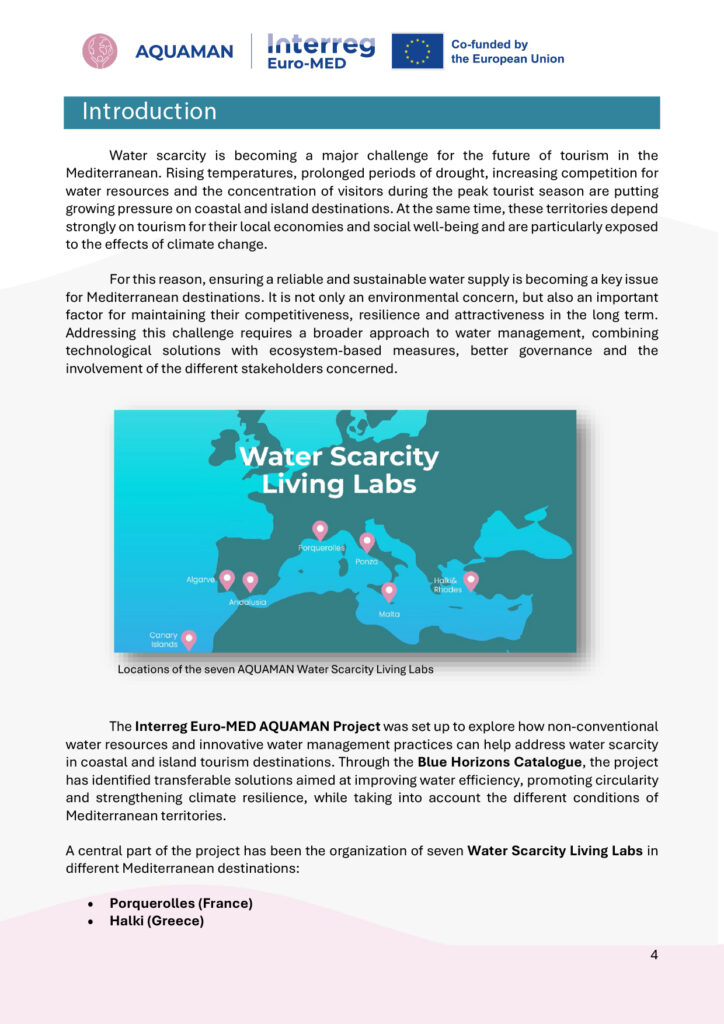
The Water Scarcity Living Labs were organised in Porquerolles (France), Halki (Greece), Ponza (Italy), Seville–Andalusia (Spain), Faro–Algarve (Portugal), Gozo (Malta) and Tenerife (Spain).
These Living Labs provided opportunities for public authorities, tourism businesses, researchers, water management organisations and local communities to exchange knowledge, discuss local challenges and identify possible solutions.
Each pilot area focused on its specific needs. For example, Porquerolles explored nature-based solutions and the restoration of traditional water systems, while Halki examined alternative water resources and circular water management. Ponza and Gozo highlighted the value of recovering historic cisterns and rainwater harvesting systems.
In Andalusia, Algarve and Tenerife, discussions focused on improving water efficiency, strengthening cooperation between institutions and involving the tourism sector in more sustainable water management.
Common lessons for a more water-resilient Mediterranean
Despite their different geographical and environmental conditions, the seven Living Labs identified several common priorities.
One of the main conclusions is that water scarcity cannot be addressed through technology alone. Effective solutions require better cooperation between public authorities and businesses, stronger community participation and long-term planning.
The report also highlights the potential of non-conventional water resources, including rainwater harvesting, reclaimed water, greywater reuse and renewable energy-powered desalination.
Another important finding is the need to combine innovative technologies with traditional Mediterranean water management practices, making use of local knowledge and existing infrastructure.
Seven strategic recommendations to guide future action
Building on the results of the Living Labs, the report presents seven strategic recommendations to support Mediterranean destinations in their transition towards more sustainable water management.
These recommendations focus on increasing the use of alternative water resources, combining innovation with traditional knowledge, improving cooperation between institutions, supporting small and medium-sized tourism businesses and promoting responsible water consumption.
They also encourage stronger cooperation between Mediterranean regions and the use of shared indicators to monitor progress and assess the effectiveness of water management measures.
Turning local knowledge into Mediterranean-wide action
The report demonstrates how local experiences can contribute to wider European objectives related to climate adaptation, sustainable tourism and the circular economy.
It also shows the value of the Living Lab approach as a way to bring different stakeholders together, exchange experiences and develop solutions adapted to local needs.
Through these shared results, AQUAMAN provides practical knowledge and recommendations that can be transferred to other Mediterranean coastal and island destinations.
The report represents an important contribution to building a more water-efficient and climate-resilient Mediterranean, where sustainable tourism development goes hand in hand with the protection of natural resources and the well-being of local communities.
Conclusions and recommendations from the Interreg Euro-MED AQUAMAN Project Water Scarcity Living Labs