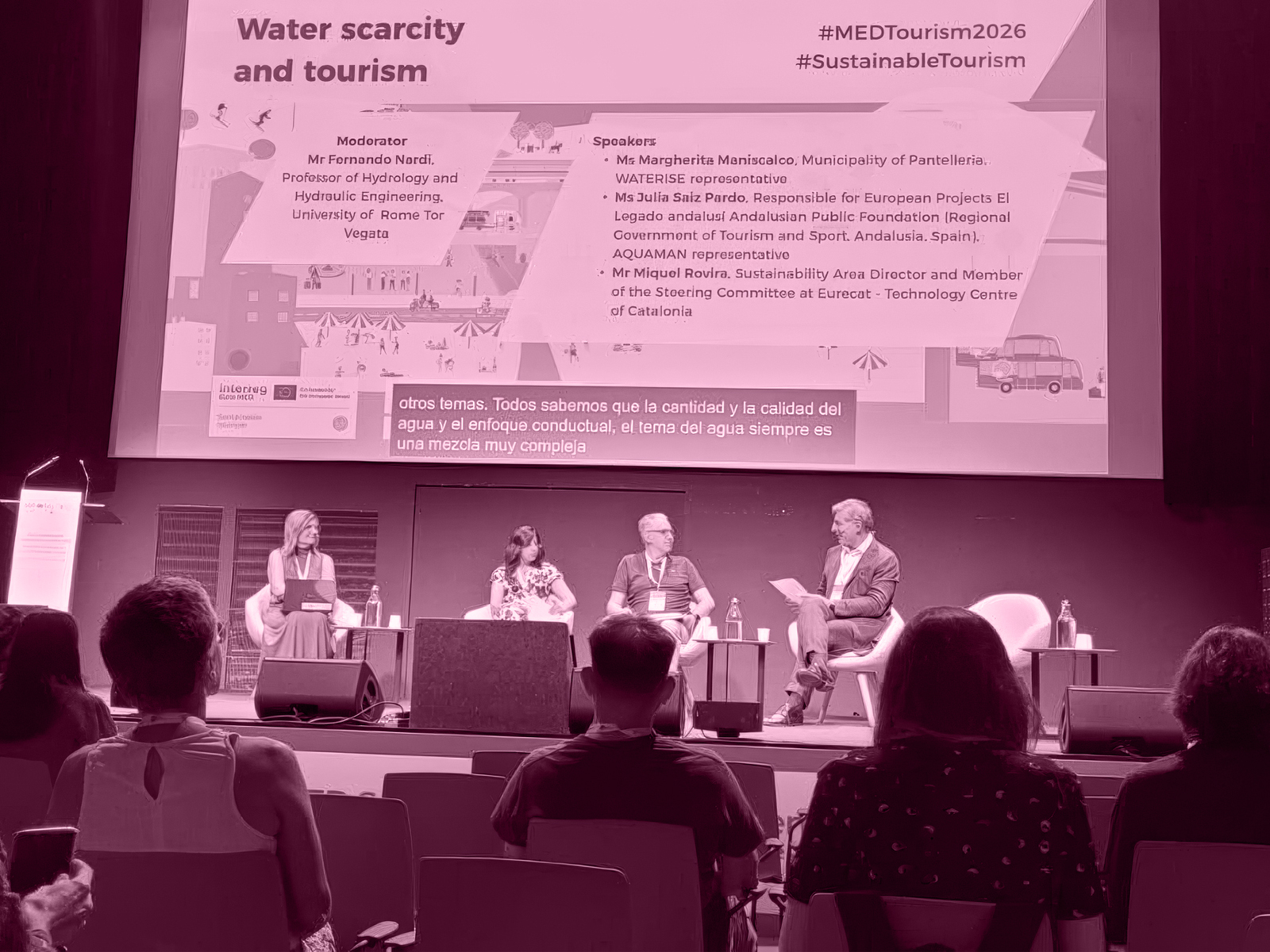

We participated in the roundtable discussion on ‘Water Scarcity and Sustainable Tourism”.
As the Mediterranean faces unprecedented environmental pressures, the critical intersection of water scarcity and tourism took center stage at the III MED Sustainable Tourism Convention in Barcelona last 19 June. The event, organized by the Interreg Euro-MED Community4Tourism Project.
A central highlight of the convention was the dedicated roundtable discussion titled “Water Scarcity and Tourism.” The AQUAMAN Project played a pivotal role in this session, contributing incomes into how vulnerable coastal and island destinations can balance the demands of peak tourist seasons with long-term water security.
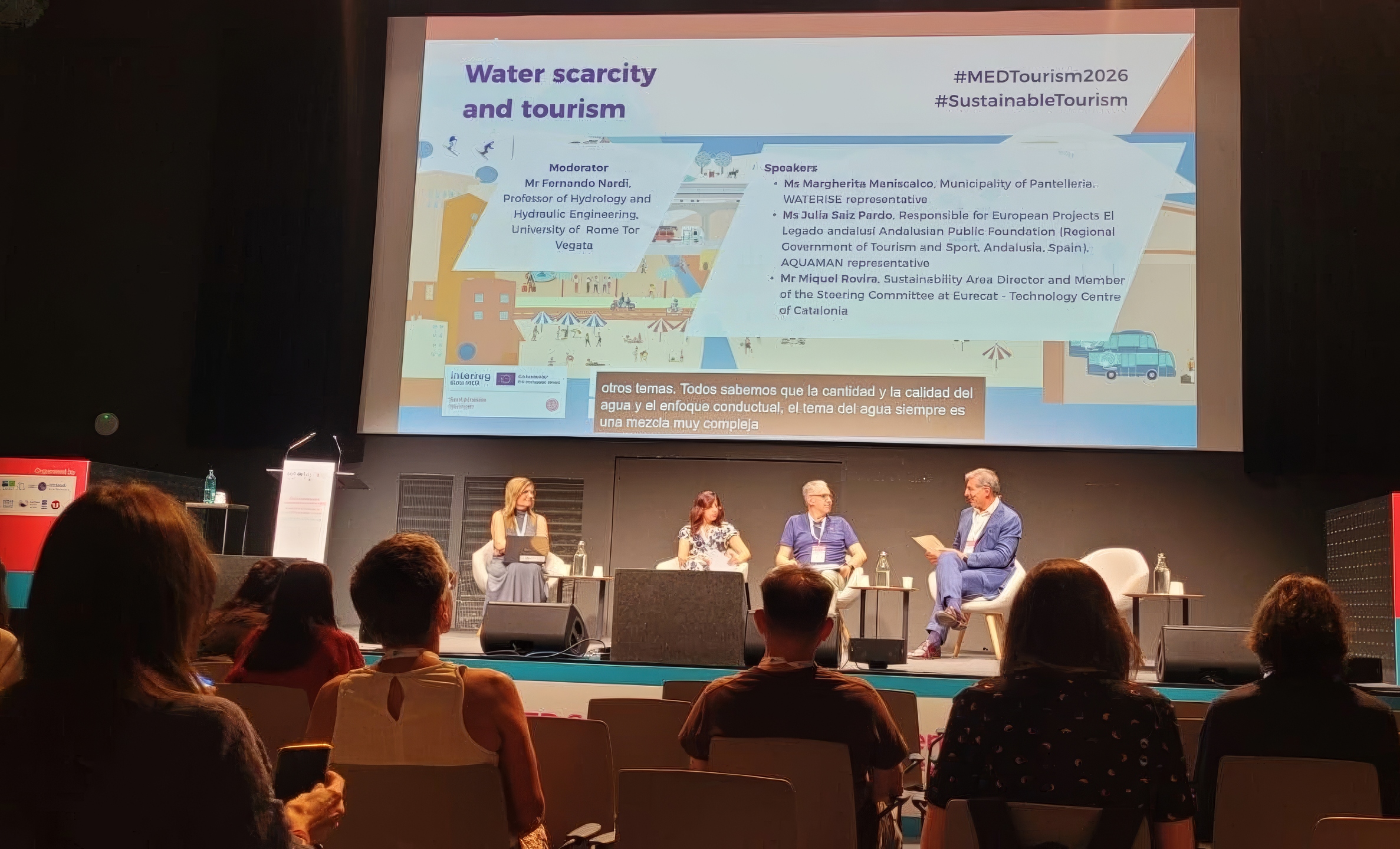
The roundtable was moderated by Prof. Fernando Nardi from the University of Rome Tor Vergata, a key partner in the AQUAMAN Project. It counted on the participation of Municipality of Pantelleria, representing the Interreg Euro-MED WATERISE Project, who shared practical insights from an island perspective on decentralized water solutions; El Legado Andalusí Andalusian Public Foundation, (Regional Ministry of Culture and Sport of Andalusia), representing the Interreg Euro-MED AQUAMAN Project, who emphasized the cultural and institutional frameworks necessary for regional adaptation and Eurecat – Technology Centre of Catalonia), who provided a technological viewpoint on advanced water treatment and circular economy practices.
Driving collaborative governance
The debate moved beyond identifying problems to exploring actionable, innovative solutions. Panelists debated cutting-edge methods to reduce water consumption in hospitality and leisure sectors, boost overall water-use efficiency through smart technologies, and implement robust, integrated water governance systems.
The panelists emphasized that infrastructure upgrades alone are not enough; the true key to long-term resilience lies in knowledge transfer, cross-border cooperation, and stakeholder engagement. By bridging the gap between scientific research, local governance, and the private tourism sector, Mediterranean destinations can better anticipate shortages and implement fair, efficient water-saving practices.
Spotlighting the AQUAMAN catalogue of transferable solutions
To showcase how these strategies can be applied practically on the ground, El legado andalusí Andalusian Public Foundation (LP of AQUAMAN Project) highlighted several key case studies featured within the AQUAMAN Catalogue of Transferable Solutions. These examples demonstrate Nature-Based Solutions (NBS) and heritage-driven techniques that offer tangible relief to water-stressed regions: Bringing back historic rainwater cisterns (Pantelleria, Italy & Kerkennah Islands, Tunisia): For centuries, local populations survived by catching rainwater from their roofs and storing it in underground stone reservoirs. While modern piping systems led to their neglect, these ancient stone cisterns are now being repaired. This low-cost, high-impact solution allows communities to collect abundant free water for irrigation and cleaning, taking massive pressure off local aquifers. Restoring natural lakes and streams (Chadwick Lakes, Malta): After suffering from severe environmental degradation and heavy silt blocking the water flow, this valley underwent a major restoration project. By clearing mud, removing invasive plant species, and rebuilding historical, small mud-and-stone dams, the valley now safely stores water in the ground, prevents local flooding, and provides a gorgeous green space for tourists and residents. Green roofs for climate and water resilience (Għajn National Water Conservation Centre, Malta): Vegetation-covered roofs absorb and retain rainwater while naturally cooling buildings and cities during hot Mediterranean summers. A prime example is the green roof installed at the Għajn Centre, a collaborator of AQUAMAN’s partner, the Energy and Water Agency of Malta, which showcases how urban tourist areas can improve air quality and boost biodiversity.
Shaping future policy
Beyond local technical fixes, the roundtable addressed the institutional framework required to scale up these initiatives. The discussion wrapped up by showcasing strategic policy recommendations in Nature-Based Solutions (NBS), heavily drawing from the results of the White Paper on Islands as hubs for climate resilience, developed by the Interreg Euro-MED Dialogue4Tourism Project. This document serves as a roadmap for turning Mediterranean islands into pioneering hubs for sustainable governance and environmental stewardship.